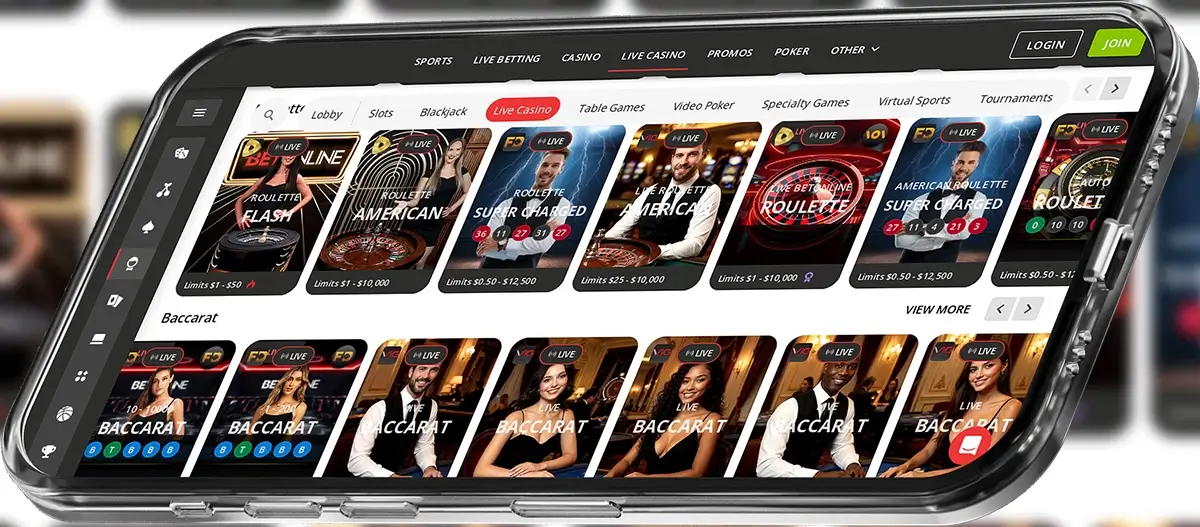
In 2026, we can definitely say that live online casinos in the US are no longer a niche product, as there are many offshore and state-licensed real-money casino sites. Each one requires its live dealer studios to meet the same testing and geolocation rules as the rest of the game providers in the casino lobby. So for players who want to try live dealer games outside the regulated states, US-facing offshore casino sites fill the gap with studios that stream blackjack, roulette, baccarat and game shows 24/7. That creates a market with two paths for U.S. players, and this guide covers both.
First, we would like to mention that all sites from our list are tested the same way. We have checked every live dealer lobby, counted the tables, checked the studios behind the streams, and played low-stakes bets on desktop and mobile. Another important thing that we checked was the bonus terms, because players need to know whether live tables contribute to wagering requirements; we also checked the cashier section, the licence and the customer support response. A casino only made the list if its live dealer product was more than a tab with three tables and a marketing line and, of course, if players from the United States were accepted.
The range is wide. SuperSlots runs two live lobbies with different limits. Bovada spreads more than 80 tables across three studios. CasinoMax keeps a $1 blackjack seat next to a high-limit room. Some operators treat live dealer games as a side dish and some treat them as the main event. That difference matters more than the size of the welcome bonus, because a player who spends most of a session at live tables will not get much value from a slots-only coupon.
The sections below will explain all the important things, such as the legality, the way a live round works, the games that fill US lobbies, the studios that supply them and the bonus rules. The next list shows you our recommendations, with pros and cons for each online casino, giving the detail that separates an excellent live casino from a good one.


Real-money live casinos are legal in the United States only where a state has passed an online casino law and issued licences. The USA does not have a single online casino market, and North America has no federal regulator for it. As of late 2026, that list covers Connecticut, Delaware, Michigan, New Jersey, Pennsylvania, Rhode Island and West Virginia. Maine has passed a law but had not launched a live market at the time of writing. Nevada allows online poker but not online casino games, which is a distinction that catches people out.
There is no federal ban on a player joining a live casino. The Wire Act of 1961 and the Unlawful Internet Gambling Enforcement Act of 2006 target operators and payment processors, not the person placing a bet. That is why the legal question is decided state by state. A player in New Jersey can join a licensed site with geolocation checks, while a player in Texas cannot. The same site may be legal in one state and unavailable in the next.
The regulated states run tight systems. New Jersey's Division of Gaming Enforcement, the Pennsylvania Gaming Control Board, the Michigan Gaming Control Board and the West Virginia Lottery all approve the studios, the random number generators, the game rules and the advertising. Most live dealer games in the United States are streamed from studios in New Jersey, Pennsylvania, Michigan, Connecticut and West Virginia, and the footage is retained for disputes. Players must be 21 and physically inside the state. A VPN will not pass the geolocation check, and a player who crosses a state line can lose access in the middle of a session.
Offshore sites are a different category. The casinos in our list hold licences in Curaçao, Anjouan or Costa Rica and accept players from states without an online casino law. They are not state-licensed, so they do not carry the same deposit protection or dispute process. That does not make them illegal for the player in most states, but it does mean the player has fewer remedies if a payout goes wrong. Anyone who wants the full state protection should stay with a licensed operator inside the seven regulated states. Anyone who lives elsewhere has to weigh the wider game choice against the lighter oversight.
The practical answer is simple. Check the state first, then check the licence. A live dealer online casino in the United States that shows a state regulator and a geolocation check is the safest route. A US-facing site should publish its licence, its studio partners and its withdrawal rules before a player deposits. If any of those details are missing, the site is not ready for a live bankroll.
A live casino is an online casino that streams a real dealer from a studio or a casino floor. The dealer shuffles physical cards, spins a real wheel or throws real dice, and the result reaches the player through an encrypted video feed. A live dealer casino game is not resolved by a random number generator, although the platform still uses software to settle bets and track side wagers. The format works because it keeps the rules of the table and adds the pace of a real room.
The live casino lobby is usually a separate tab inside the casino. It lists tables by game, stake and dealer language. A player can join a blackjack seat, watch a few hands before betting and leave at any time. That flexibility is the main reason live dealer casino sites have grown so quickly. The format keeps the social feel of a land-based casino without the travel, and it gives players a way to check the pace before committing a bankroll.
Live Dealer Casinos Online are not all built the same. A live casino site may run a single Visionary iGaming studio with four tables, or it may carry hundreds of tables from Evolution, Ezugi, Pragmatic Play, Playtech and smaller studios. The live casino tables can be classic blackjack, roulette and baccarat, or game shows with hosts and multipliers. Players who want to play live casino games online can find both formats at most of the sites in our list, but the depth changes from one operator to the next. The best live casino for one player is often the one that matches the games they actually play, not the one with the longest provider list.
Live dealer games are available at every casino in our list, but the depth varies. SuperSlots runs two separate floors, Bovada spreads its tables across three studios and CasinoMax keeps a small four-game floor with a low minimum. That range is normal. A player who wants a quiet $1 blackjack table has different needs from a player chasing a $50,000 hand or a game show multiplier. The best live casino sites make that difference clear before a player deposits.
Live dealer casinos work through a chain that starts in a studio and ends in the player's account. The studio has cameras, microphones, card shoes, wheels and a dealer console. The dealer sees the bets and chat on a monitor, while the platform converts each card scan or wheel result into data that settles the wager. The video is compressed and sent through streaming servers, which keeps latency low enough for a betting window to close at the right moment.
A player who wants to play live dealer casino games for the first time should start with a low-stakes table. The online live dealer lobby lists the limits before the seat is taken, so there is no surprise after the cards are dealt. A short observation round is enough to learn the interface, and the dealer will usually answer a simple question between hands.
Start with a site that publishes its licence and accepts players from your state. A regulated operator will run a geolocation check before the first bet. An offshore site should still show its licence, studio partners and cashier rules. If the site hides those details, move on.
Most sites ask for an email, a password and a date of birth. Regulated operators may ask for the last four digits of a Social Security number or a government ID before the first deposit. Offshore sites often wait until the first withdrawal. Either way, sending documents early avoids a delay later.
Crypto is the fastest route at most US-facing sites, and Bitcoin, Litecoin, Ethereum and USDT are common. Cards and e-wallets work too, but they can carry fees and slower cashouts. Check the minimum deposit before claiming a bonus, because a $20 minimum can rule out a small first test.
The live casino tab lists the tables. Filter by game, limit or dealer. A new player should watch a round before betting to learn the interface. The chat box, bet controls and history panel are usually in the same places across studios, but the layout changes from provider to provider.
Live blackjack tables usually seat seven players, while roulette and baccarat can take many more. The bet timer shows how long is left. A player who joins late should wait for the next round instead of rushing a bet. The table limit is displayed before the seat is taken, so there is no surprise after the cards are dealt.
The dealer calls the result and the platform credits the win. Chat is moderated, and a dealer may answer a question between rounds. The live dealer product is social, but it is not a private table. A player should keep the chat civil and avoid sharing account details.
Withdrawals follow the casino cashier, not the studio. A crypto cashout can clear in minutes, while a bank wire can take days. If a bonus is active, check the contribution rate first. Most live tables contribute nothing, and some sites cap the bet while bonus funds are in play.
The live casino tech behind the screen matters less than the licence and the studio. A licensed studio keeps logs of every round and stores footage for disputes. That is the difference between a live dealer section that can resolve a dispute and one that leaves the player arguing with a chat agent. The best live dealer casinos publish those details, and the weakest ones bury them.

The most popular live casino games in U.S. lobbies are still blackjack, roulette and baccarat. Those popular live casino games sit alongside game shows and poker-style tables, which fill a smaller but loyal niche. The mix changes by studio. Visionary iGaming and Fresh Deck Studios focus on classic live dealer casino games, while Evolution and Pragmatic Play carry the larger game-show catalogs in regulated markets. The best live casino games for a new player are the ones with simple rules and a low minimum.
Live blackjack is the flagship live casino game. A live dealer blackjack game usually seats seven players, uses eight decks and pays 3:2 on a natural. Variants add side bets such as 21+3 and Perfect Pairs, and some tables offer Early Payout or Bet Behind. BetUS runs live casino blackjack limits from $1 to $10,000, while CasinoMax starts at $1 and SlotoCash names its dealers. Bovada lists 47 live dealer blackjack games, and the live dealer blackjack tables there are the deepest in our list.
Live roulette comes in European and American formats. The single-zero European wheel carries a 2.7% house edge, while the double-zero American wheel carries 5.26%. That difference matters over a session. BetUS spreads European roulette from $0.50 to $12,500, and Bovada lists 19 roulette tables. A player who wants the best odds should choose European or French roulette whenever the lobby offers it.
Live dealer baccarat is simple to learn and fast to play. The banker bet carries a 1.06% house edge after commission, the player bet carries 1.24% and the tie bet is a much weaker 14.36%. Super 6 is a popular variant that pays 12:1 on a six-point banker win and removes the commission. Bovada runs 15 baccarat tables, and most of our listed casinos carry at least one standard table.
Live dealer poker games are played against the house, not against other players. The common titles are Three Card Poker, Ultimate Texas Hold'em, Caribbean Stud and Casino Hold'em. Ultimate Texas Hold'em has an RTP of 97.82% on the main game and 99.47% on the total bet when the player follows the optimal strategy. Three Card Poker sits lower at 96.63%. These games reward a player who learns the raise chart before sitting down.
Live dealer craps uses a mechanical arm to launch the dice, which keeps the game honest and gives the table a distinct rhythm. The pass line with full odds is one of the better bets in the building, while the proposition bets carry a much larger house edge. Craps is less common than blackjack or roulette in US-facing lobbies, so a player should check the live dealer section before depositing.
Game shows blend a host, a wheel or a bonus round with a betting interface. Dream Catcher has an RTP of 96.64%, Crazy Time sits near 96%, Crazy Coin Flip is around 96.05% and Football Studio is around 96.27%. These titles are not available at every casino in our list. Bovada carries Wheel of Fortune and Crypt of Giza, while the smaller RTG-based sites stick to classic tables.
Sic Bo and Dragon Tiger are fast card and dice games that suit players who want a quick round. Lucky Tiger carries BetGames TV versions of Live Bet on Sic Bo, Dragon Tiger and War. The pace is quicker than a standard baccarat table, and the betting interface is simpler. A player who finds blackjack too slow may prefer this format.
Live dealer hold'em is a house-banked poker game, not a tournament. The player receives two cards and the dealer receives two, and the better hand wins after the community cards are revealed. It is a useful bridge for a poker player who wants a live table without the variance of a cash game. The rules and payouts vary by studio, so read the table card before betting.
The live dealer titles above cover most of the lobby. A player who wants the widest choice should look for a site with more than one studio. SuperSlots, Bovada, BetUS, Decode and Lucky Tiger all carry two or more live providers, which means a backup table is usually open when the main floor is full. A single-studio site can still be good, but the choice is narrower and the table limits are less flexible.
Live dealer games and regular online casino games solve different problems. A live table gives the player a real dealer, a video feed and a social pace. A regular game gives speed, privacy and a lower minimum bet. Neither is better in every case. The right choice depends on whether the player wants company or volume.
| Feature | Live dealer | Regular online casino game |
|---|---|---|
| Outcome source | Physical cards, wheel or dice | Random number generator |
| Pace | Slower, with a dealer and a bet timer | Fast, with a new round on demand |
| Minimum bet | Usually $1 to $10 | Often $0.10 or less |
| Social element | Chat and a live dealer | None |
| Bonus contribution | Often 0% | Usually 20% to 100% |
| Demo play | Not available | Common on slots and table games |
| Connection | Needs a stable stream | Works on a weaker connection |
| House edge | Depends on the game and rules | Depends on the game and rules |
The house edge is not automatically worse on a live table, but the pace changes the exposure. A live blackjack game may deal 40 to 60 hands an hour, while an RNG blackjack game can deal several hundred. A player who uses perfect strategy will lose less per hour at the slower table, even though the edge per hand is similar. That is why live dealer play suits a player who wants a controlled session and a fixed budget.
The best online live casino for a bonus hunter is not the same as the best for a high roller. The top online live casino sites publish the table limits before the seat is taken, and most online live casino sites list the studio behind each table. Live dealer online casino games are slower than RNG games, and a live dealer casino online session is easier to control when the player sets a timer. The live dealer online casino sites in our list all carry a mobile browser lobby.
The bonus rules are the bigger difference. Most live dealer games contribute nothing toward wagering, and some casinos exclude them from free spins and cashback. A player who wants to clear a bonus should do it on slots or RNG tables, then move to the live floor with the remaining bankroll. A player who ignores that rule can grind a 40x requirement on live blackjack and never clear it.
There is also a practical limit. A player who wants to play live casino online, or live dealer games online, needs a stable connection and a device that can decode the stream. The live casinos online that run both live and RNG tables give a player more flexibility, and the best live casinos online make the bonus contribution easy to find before the first bet. A weak mobile signal can drop a hand, and a player who loses connection during a live round may have the bet settled by the table result. RNG games are more forgiving. A player on a train or a poor hotel network should stick to regular games and save the live table for a stable connection.
The best approach is to use both. A player can warm up on a low-stakes RNG table, move to a live table for the social session and return to RNG play for a bonus grind. The live casino online experience is not a replacement for the rest of the lobby. It is a different way to play the same games.
Live casino software comes from a small group of studios. Evolution Gaming is the largest, and it owns Ezugi, NetEnt, Red Tiger and Big Time Gaming. Playtech is the other major supplier in regulated US markets. Pragmatic Play has a strong global live portfolio but had not launched in the United States at the time of writing. The US-facing offshore market adds Visionary iGaming, Fresh Deck Studios, BetGames TV, Vivo Gaming and Iconic21. The live casino platforms that carry more than one studio give players a backup table when the main floor is full.
| Studio | US presence | Known for | Where players find it |
|---|---|---|---|
| Evolution Gaming | Studios in Connecticut, Michigan, New Jersey, Pennsylvania and West Virginia | Live blackjack, roulette, baccarat, craps and game shows such as Crazy Time and Dream Catcher | State-licensed casinos in the regulated markets |
| Ezugi | Owned by Evolution, with a global live catalog | Classic tables and local-language dealers | International and offshore lobbies |
| Playtech | Live dealer games in New Jersey since 2021 | Classic tables and Adventures Beyond Wonderland | New Jersey licensed operators |
| Pragmatic Play | Not launched in the US at the time of writing | Mega Wheel, Dragon Tiger, Mega Sic Bo, Sweet Bonanza Candyland and PowerUp Roulette | Global and offshore lobbies |
| Visionary iGaming | US-facing offshore market | Blackjack, roulette, baccarat, Super 6 and named dealers | SuperSlots, Bovada, BetOnline, BetUS, CasinoMax, Decode, Everygame, SlotoCash and Lucky Tiger |
| Fresh Deck Studios | US-facing offshore market | High-limit blackjack, roulette and baccarat | SuperSlots, BetOnline, BetUS and Decode |
| BetGames TV | US-facing offshore market | Live Bet on Sic Bo, Dragon Tiger and War | Lucky Tiger |
| Vivo Gaming | Global live dealer supplier | Multi-language tables and game shows | International lobbies |
| Iconic21 | Global live dealer supplier | Live Crash and interactive formats | Selected international lobbies |
The live dealer studios behind a casino matter for three reasons. First, the studio controls the table limits and the game variants. A site that carries only Visionary iGaming will not have the Evolution game-show catalog. Second, the studio controls the stream quality and the backup systems. A studio with redundant servers is less likely to drop a table at peak hours. Third, the studio controls the dispute log. A licensed studio keeps footage and round data, which gives the player a trail if a result is disputed.
The live dealer software providers in the table above are not interchangeable. Evolution and Playtech are the safest choices in a regulated state because their studios are approved by the local regulator. Visionary iGaming and Fresh Deck Studios are the practical choices for a US-facing offshore site because they have served that market for years. Pragmatic Play is a strong global brand, but a US player will not find its live tables at a state-licensed site until it launches.
A casino that lists a studio logo but cannot show a table is not a live casino. The same applies to a site that carries one table from a major studio and calls itself a live dealer specialist. Players should open the lobby and count the tables before depositing. The best live casino software providers give a site depth, not a badge.
Live Casino Bonuses are the most misunderstood part of the market. Most welcome offers are built for slots, and live tables are either excluded or contribute a small percentage. A 100% match with 30x wagering can look generous until the terms reveal that live blackjack contributes nothing. The player then has to clear the bonus on slots before touching the live floor.
A deposit match adds a percentage of the deposit as bonus funds. SuperSlots offers 250% up to $6,000, Decode offers 111% up to $1,111 and Bovada offers up to $3,750 on crypto. The catch is the wagering requirement and the game contribution. A live table usually contributes 0%, so the match is a slots bonus in practice.
A free chip is a small no-deposit bonus. Decode gives $10 automatically, and Lucky Tiger offers $25 with code 25LUCK. The cashout is usually capped, and the eligible games are often slots only. A player should read the cap before treating the chip as a live-table bankroll.
Reload bonuses reward a second or third deposit. Cashback returns a percentage of net losses. SuperSlots runs a daily $15,000 race that counts live dealer play, and CasinoMax offers comp points and a Blue Rewards Card. These offers are often more useful to a live player than a large welcome match because they do not require a slots grind.
Live casino tournaments are less common than slot tournaments, but some sites run leaderboards across blackjack and roulette. The prize is usually cash or bonus credits. A player should check whether the leaderboard counts live hands and whether the prize carries wagering. A cash prize with no rollover is worth more than a larger bonus with a 40x requirement.
The live dealer bonus contribution is the number to check first. Bovada and CasinoMax both state that live dealer games contribute 0%. BetOnline counts table games at 10%, and BetUS counts most table games at 5% to 20%. SlotoCash applies a 50x playthrough to live games when bonus funds are used. Those numbers decide whether a bonus is compatible with a live session.
There is a second trap. Some casinos cap the maximum bet while bonus funds are active. CasinoMax limits bets to $10, and SuperSlots applies a $10 cap while a bonus is active. That cap can be below the minimum on a high-limit table, which makes the bonus useless for a player who wants the Black room or a $25 minimum. A player should check the cap before opting in.
The best live dealer casino bonuses are usually the small, flexible ones. A reload bonus with a low wagering requirement, a cashback offer with no cap or a tournament prize paid in cash can be worth more than a headline match. The live dealer game availability also matters. A bonus that cannot be used on live tables is not a live casino bonus, no matter how the landing page describes it.

The mobile live dealer casinos are now the default for the majority of the casino players. The streams are built in HTML5, so they run in a mobile browser on iOS and Android without a download. A native app can add push notifications and a shortcut, but it is not required for the live floor. The quality of the connection matters more than the app store badge.
Live Dealer Apps are the exception in this market. BetOnline advertises a dedicated mobile app, while Bovada, BetUS, Everygame, CasinoMax, SlotoCash and Lucky Tiger run browser-only live lobbies. Decode and SuperSlots also work through the browser. That is not a deal breaker. A browser session avoids storage limits and updates, and the live stream is the same product. A player who wants a home-screen shortcut can add the site to the device without an app. The best live casino apps add push notifications, but they do not change the tables.
The live dealer options for mobile are narrower than desktop at some sites. SlotoCash restricts many table games on mobile but keeps the live dealer tables available. Everygame and Lucky Tiger carry the full live catalog in the browser. Bovada makes all 600-plus casino games available on mobile, including the live floor. A player should test the live tab on the phone before depositing, because a site that works well on desktop can have a cramped betting interface on a small screen.
Data use is the other practical issue. An HD live stream can consume a significant amount of mobile data over an hour. A player on a limited plan should use Wi-Fi or lower the stream quality if the interface offers it. Battery drain is also higher than RNG play. A charged device and a stable connection are more important than a large screen.
The live casino app market may grow, but the current product is browser-first. That is good news for players who do not want another app. The live casino games on mobile are the same tables, the same limits and the same dealers. The only difference is the size of the interface and the quality of the network.
Choosing a live casino is a process of elimination. A player should start with the licence and the state rules, then narrow the list by games, limits, bonus terms and banking. The biggest mistake is to pick a site for the welcome bonus and then discover that the live floor is thin or the bonus excludes the tables. The top live dealer casinos in our list pass the first filter, but the right one for a player depends on the bankroll and the games.
A regulated site will name the state regulator and run a geolocation check. An offshore site should publish its licence and its restricted countries. If the site does not say where it is licensed, it is not a safe place for a live bankroll.
A live casino with one studio and four tables is not the same as a site with three studios and 80 tables. Count the blackjack, roulette and baccarat tables, then check whether the site carries game shows. A player who wants variety should look for more than one live dealer provider.
A $1 minimum suits a casual player, while a $25 minimum suits a larger bankroll. BetUS, Bovada and CasinoMax cover a wide range. A site with only $10 to $100 limits will frustrate a high roller, and a site with $25 minimums will exclude a small bankroll.
Check whether live dealer games contribute to wagering and whether the site caps the bet while a bonus is active. A bonus that cannot be used on live tables is not a live casino bonus. A cashback or race with no wagering is often the better fit.
Open a table on desktop and mobile before depositing. Watch for buffering, check the bet timer and try the chat. A live dealer table should load in a few seconds and the controls should be clear. A stream that drops during a test will drop during a real session.
A live win is only useful if the cashout arrives. Check the withdrawal methods, the fees and the processing time. Then test support with a simple question. A site that answers within a few minutes on chat is easier to trust than one that hides behind an email form.
A player should start with a low-stakes table and a fixed budget. The live casino experience is slower than RNG play, so the bankroll lasts longer and the session is easier to control. A player who wins should cash out a portion rather than chase a bigger table.
The best live casino site is the one that fits the player, not the one with the biggest logo. A high roller should look at Bovada or BetUS for limits. A casual player should look at CasinoMax or SuperSlots for low minimums. A game-show fan should look at Bovada, while a player who wants named dealers should look at SlotoCash. The live casino reviews in our database explain the trade-offs for each one.
Live dealer odds are set by the game rules, not by the stream. A live roulette wheel has the same house edge as an RNG wheel with the same number layout. A live blackjack table has the same edge as an RNG table with the same rules. The difference is the pace and the number of hands per hour. That is why two players can play the same game and get very different results over a session.
| Game | Typical RTP | House edge | Notes |
|---|---|---|---|
| Blackjack (basic strategy) | 99.5% | 0.5% | Depends on rules such as 3:2 payout, dealer hits soft 17 and double after split |
| European roulette | 97.3% | 2.7% | Single-zero wheel |
| American roulette | 94.74% | 5.26% | Double-zero wheel |
| Baccarat banker | 98.94% | 1.06% | After the 5% commission |
| Baccarat player | 98.76% | 1.24% | No commission |
| Baccarat tie | 85.64% | 14.36% | High variance and a weak bet |
| Ultimate Texas Hold'em | 97.82% | 2.18% | Main game, with 99.47% on the total bet under optimal strategy |
| Three Card Poker | 96.63% | 3.37% | Pair Plus and ante bonuses change the figure |
| Dream Catcher | 96.64% | 3.36% | Money wheel with multiplier segments |
| Crazy Time | 96% | 4% | Bonus rounds add volatility |
| Crazy Coin Flip | 96.05% | 3.95% | Optional top-up round |
| Football Studio | 96.27% | 3.73% | High card game |
The figures are long-run averages, not a promise for a single session. A player can win for hours at a game with a 5% house edge and lose for hours at a game with a 1% edge. The RTP tells the player what happens over hundreds of thousands of hands. It does not tell the player what happens on a Friday night with a $200 bankroll.
The live dealer game statistics that matter most are the ones the casino publishes. A licensed studio tests its equipment and its random number generators, and the results are available through the regulator or the testing lab. A site that publishes an RTP figure for its live tables is easier to trust than one that leaves the number out. A site that claims a live table can be beaten by a system is selling a fantasy.
The best way to use the table is to compare games before betting. A player who wants a low edge should choose blackjack with good rules, European roulette or baccarat banker. A player who wants a big multiplier should accept the higher volatility of a game show. The odds do not change because the dealer is real. The discipline does.
The US live dealer map is not a single market. Each regulated state has its own regulator, its own launch date and its own set of approved studios. A site that operates in New Jersey may not operate in Pennsylvania, and a site that operates in Michigan may not operate in West Virginia. The table below shows the seven states with real-money online casino gaming and the live dealer status in each one.
| State | Online casino status | Live dealer studios | What players should know |
|---|---|---|---|
| New Jersey | Legal since 2013 | Evolution and Playtech | The largest online casino market in the United States, with a deep live floor and multiple operators |
| Pennsylvania | Legal since 2017 | Evolution | A large market with licensed operators and geolocation checks at the border |
| Michigan | Legal since 2021 | Evolution | Strong live table choice and a growing operator list |
| West Virginia | Legal since 2019 | Evolution | Smaller market with a focused live lobby |
| Connecticut | Legal since 2021 | Evolution | Dedicated studio serving local brands |
| Delaware | Legal since 2013 | No dedicated studio | Small market with a narrower live catalog |
| Rhode Island | Legal since 2024 | No dedicated studio | Newest regulated market, still building its live floor |
| Maine | Law passed, launch pending | Not yet live | No real-money live dealer market at the time of writing |
Live dealer games in the US are available only to players who are physically inside a state that licenses them. The geolocation check uses the device location, the IP address and the account history. A player who travels to a state without a live market cannot take the tables along. A player who uses a VPN to fake a location is breaking the operator's terms and may lose the account and the balance.
The state map also explains why the offshore market exists. A player in Texas, Florida, Illinois or California does not have a state-licensed online casino, so the only real-money live dealer options are offshore sites or sweepstakes platforms. The offshore sites in our list accept players from most states, but they do not carry a state licence. The player gets a wider live floor and crypto banking in exchange for lighter consumer protection.
Players searching for live casinos in the US should start with their own state. If the state is on the regulated list, a licensed operator is the safer choice. If it is not, a US-facing offshore site with a clear licence and a tested cashier is the practical alternative. The top US live online casino sites are not the same for every player, and the state line is the first filter.
Live casino winnings are taxable income in the United States, whether the bet was placed at a state-licensed site or an offshore one. The federal government taxes gambling winnings as ordinary income, and the state adds its own rate in most cases. The casino does not always issue a form. A player is still expected to report the win.
The reporting rules differ by game. Slot winnings of $1,200 or more, or 300 times the wager, usually trigger a W-2G. Table game winnings do not have the same automatic threshold, but the income is still taxable. A live blackjack or roulette win may not produce a form at the table, which is why players should keep their own records. A session log with dates, stakes and results is enough for most casual players.
State rates vary widely. New Jersey taxes gambling winnings as ordinary income, and the top rate is among the highest in the country. Pennsylvania applies a 3.07% flat rate. Michigan applies 4.25%. West Virginia applies 6.5%. Connecticut applies 6.99%. Delaware applies 6.6%. Rhode Island applies 5.99%. States without an income tax, such as Nevada, Texas, Florida and Washington, do not add a state tax on the win, although the federal tax still applies.
The federal withholding rule is separate from the tax rate. A casino may withhold 24% of certain large winnings, and a nonresident alien may face a 30% withholding rate. A player who wins a jackpot should ask the casino for the tax form and keep a copy. A player who loses during the year may be able to deduct the losses, but only if they itemize and only up to the amount of the winnings. The standard deduction does not allow a gambling loss deduction.
This is general information, not tax advice. A player with a large live casino win should speak to a tax professional in their state. The rules change, and the treatment of a professional gambler is different from the treatment of a casual player. The safest approach is to keep records, report the win and pay the tax before the money is spent.
Sweepstakes casinos are the bridge product for states without a real-money online casino law. A player buys a package of Gold Coins and receives free Sweeps Coins, then uses those coins on slots or live dealer games. The live tables run from the same studios as the real-money sites, but the prizes are redeemed as cash, gift cards or merchandise rather than paid as chips. The model is legal in most states, with a patchwork of exclusions.
The live dealer experience is similar. A player joins a streamed blackjack, roulette or baccarat table, places a virtual bet and watches the round. The difference is the currency and the redemption rules. Sweepstakes sites often carry fewer live tables than real-money sites, and the table limits are lower. Some brands add game-show formats, while others stick to classic tables.
A real-money site accepts cash or crypto, pays winnings in cash and reports to the tax authorities. The regulated version carries state consumer protection. The offshore version carries a licence from another jurisdiction and a wider game choice. The minimum bets are usually higher and the bonus terms are more complex.
A sweepstakes site uses Gold Coins and Sweeps Coins. The live tables are real, but the prizes are redeemed under the site's rules. The minimum bets are lower and the verification can be lighter. The trade-off is a smaller live catalog and a redemption process that can take longer than a crypto cashout.
The legal treatment is different too. A sweepstakes casino is not a licensed real-money operator in most states, and the rules are still evolving. Some states have tightened the model, and others have left it alone. A player should check the site's state list before signing up. A real-money offshore site has a different risk profile, but it is also not state-licensed. Neither option replaces a regulated operator inside the seven states with a live market.
The best choice depends on the player. A player who wants a regulated live table should stay in a licensed state. A player who wants a real-money live floor and lives elsewhere should choose an offshore site with a clear licence and a tested cashier. A player who wants a lower-stakes entry point can try a sweepstakes site, but should read the redemption rules first. The live dealer games are the same. The money is not.
Live casino safety starts with the operator, not the studio. Live casino players should check the licence, the testing lab and the dispute process before depositing. The studio supplies the game and the stream, but the casino controls the account, the deposit, the withdrawal and the complaint. A site that cannot name its regulator is not a safe place for a live bankroll.
Fairness is easier to verify at a licensed studio. The equipment is tested, the cards and wheels are inspected, and the footage is retained. A regulated operator publishes the testing lab and the game rules. An offshore site should publish the studio name and the licence. A site that claims its live tables are provably fair without naming the studio is using the wrong vocabulary, because provably fair is an RNG concept, not a live dealer one.
The live dealer players who run into trouble usually do so for three reasons. They chase a loss at a higher limit. They play longer than planned because the table never closes. They ignore the bonus rules and then blame the casino when the live hands do not count. A deposit limit, a loss limit and a session timer solve the first two. Reading the terms solves the third.
Responsible gambling tools are not a formality. A live table can run for hours without a natural break, and the next round is always one click away. A player should set a budget before the first bet, take a break every hour and stop when the budget is gone. A self-exclusion or a cooling-off period is the right move when play stops being fun. The National Council on Problem Gambling runs a helpline at 1-800-522-4700, and Gamblers Anonymous and GamCare offer confidential support.
The live casino dealers are doing a job. They are not responsible for the player's bankroll, and they cannot change a result. A player who loses a hand should not take it out on the dealer or the chat. The best live casinos moderate the chat and protect the dealers. A site that lets abuse slide is not a pleasant place to spend a session.
The US live casino market has real advantages and real drawbacks. The regulated states offer the strongest consumer protection, while the offshore market offers the widest game choice. A player should understand both sides before choosing a site.
These are the questions we get most often about live dealer casinos in the US. The Live Casinos FAQs below are short, and the sections above explain the detail.
They are legal in the seven states that license online casino gaming: Connecticut, Delaware, Michigan, New Jersey, Pennsylvania, Rhode Island and West Virginia. Outside those states, a player can use an offshore site, but it does not carry a state licence. Maine has passed a law but had not launched at the time of writing.
A licensed live dealer casino is safe and fair. The studio equipment is tested, the games are monitored and the footage is retained. An offshore site is only as safe as its licence and its payout record. A player should check both before depositing.
No licensed live casino is rigged. The cards, wheels and dice are physical, and the studio is monitored. A rigged game would require the studio and the regulator to ignore the test results. An unlicensed site is a different story, which is why the licence matters.
Yes, if they are inside a state that licenses online casino gaming or if they use a US-facing offshore site. A player in a regulated state should choose a licensed operator. A player elsewhere should check the site's licence and withdrawal record.
New Jersey has the deepest live dealer market, with Evolution and Playtech studios and a large operator list. Pennsylvania and Michigan are close behind. The best state for a player is the one where they live, because the geolocation check decides access.
Some do. CasinoMax starts at $1 on live blackjack, and SuperSlots starts at $1 in its Red lobby. Other sites start at $5 or $10. A player on a small bankroll should check the table minimum before depositing.
Usually not. Most live dealer games contribute 0% to wagering, and some sites exclude them from the bonus entirely. A few sites count live games at a reduced rate. Read the terms before opting in.
The bet is usually settled by the table result. The casino keeps a record of the round, and the player can contact support if the balance does not match. A stable connection is the best prevention.
No. Live tables use real dealers and real studio time, so there is no demo mode. A player can watch a table before betting, but cannot play for free. RNG table games often offer a demo.
Yes. Every casino in our list runs the live floor in a mobile browser on iOS and Android. BetOnline also offers a dedicated app. The stream quality depends on the connection, not the app.
There is no single answer. SuperSlots is the best for two live lobbies, Bovada for table depth and high limits, BetUS for limit spread, CasinoMax for a $1 minimum and SlotoCash for named dealers. The right site depends on the bankroll and the games.
A studio streams a real dealer, the player places a bet through a digital interface and the platform settles the result from the physical cards, wheel or dice. The casino wallet handles the money. The studio handles the game.
The best live casinos in the US are not one list. They are a shortlist that changes with the player's state, bankroll and game choice. SuperSlots takes the top spot for live table depth because it runs two separate floors with different limits and studios. The Red lobby starts at $1 and the Black room goes to $5,000. The trade-off is that the biggest crypto bonus cannot be used on live tables and the $10 cap applies while a bonus is active.
Decode is the best value pick for a player who wants a low rollover. The 25x requirement leaves more of the bankroll for live hands, and the live floor covers blackjack, roulette, baccarat and Super 6. The free chip is slots-only, so a player who wants the live floor should ignore it. Bovada is the best choice for table depth and high limits, with 81 tables across three studios and a $50,000 hand limit. The catch is that live play earns no Rewards Points and contributes nothing to a bonus.
BetUS is the best pick for limit spread, with blackjack from $1 to $10,000 and European roulette from $0.50 to $12,500. The $50 minimum deposit is high for a casual player, and the table contribution is low. CasinoMax is the best pick for a $1 live minimum, although its live floor stops at four games. SlotoCash is the best pick for named dealers and the bet-behind feature, but the 50x live playthrough is a real cost. Lucky Tiger is the best pick for BetGames TV and a second live provider, while Everygame is the best pick for a long track record and a single account across two casinos. BetOnline is the best pick for same-day crypto and a $5,000 table limit.
The common thread is that every site has a trade-off. A player who wants the deepest live floor should accept a weaker bonus contribution. A player who wants a big bonus should accept a slots grind before touching the live tables. A player who wants state protection should stay in a regulated state and choose a licensed operator. The best live casino site is the one whose trade-offs match the player's priorities.
The legal picture is the other half of the decision. Live dealer casinos in the United States are legal only where the state licenses them. A player in New Jersey, Pennsylvania, Michigan, Connecticut, Delaware, Rhode Island or West Virginia can choose a regulated site. A player elsewhere should treat an offshore site as a commercial choice with a lighter safety net. Neither option is a guaranteed win, and no live dealer can remove the house edge.
The right approach is to set a budget, pick a table that suits the bankroll and treat the session as entertainment. Live casinos in the US offer more choice than ever, from a $1 blackjack seat to a $50,000 high-limit room. The best site is the one that lets a player enjoy that choice without hidden terms, slow payments or a lobby that promises more than it delivers.